March 10, 2026
Planning for urban heat resilience has long been a spatial exercise. Cities invest in tree canopy, cool pavement, green infrastructure, and shade structures. Urban designers advocate for the 15-minute city, where essential services cluster within walkable proximity. These interventions matter, but they share a common blind spot. They assume that making places better addresses how people actually use them. New research from Australia suggests a different reality: when temperatures spike, people don't just change where they go. They change when they go. This distinction has significant implications for how cities think about nighttime economies, cultural districts, and the resilience of place-based commerce.
A Shift is Already Happening
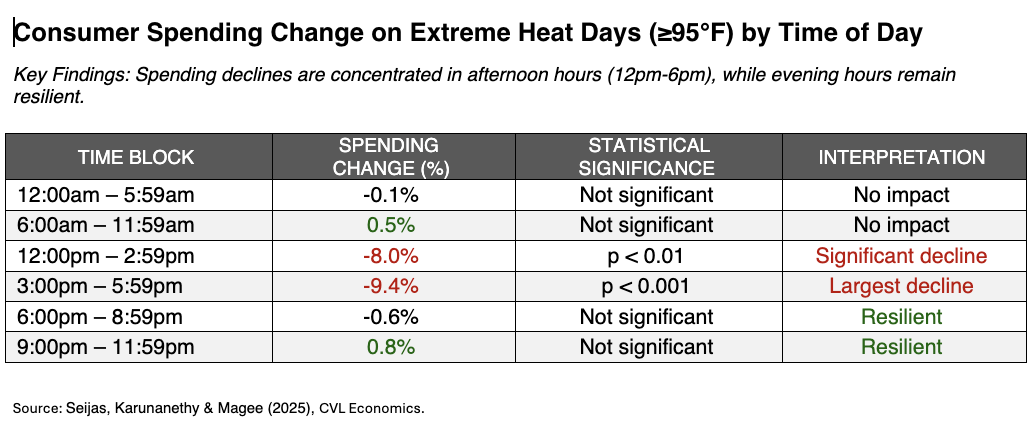
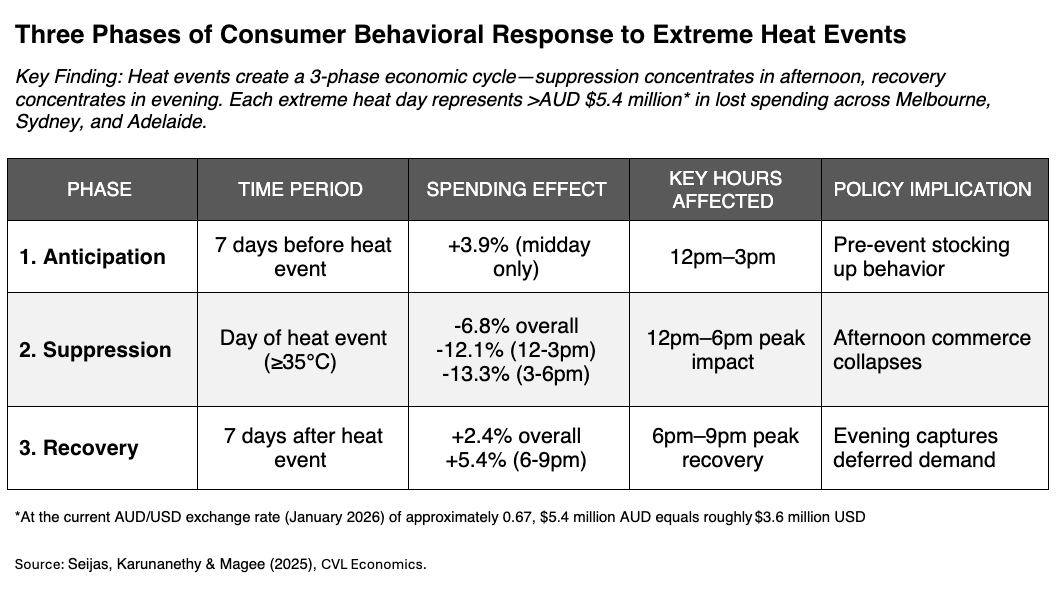
Analysis of consumer spending patterns across Melbourne, Sydney, and Adelaide reveals that extreme heat (days reaching 95°F or higher) triggers a pronounced reorganization of economic activity. Afternoon spending between noon and 6pm collapses, declining by 12% to 13% during peak heat hours. Meanwhile, morning and evening spending remains essentially stable. In the week following a heat event, early evening spending rebounds, which suggests consumers defer rather than cancel purchases.
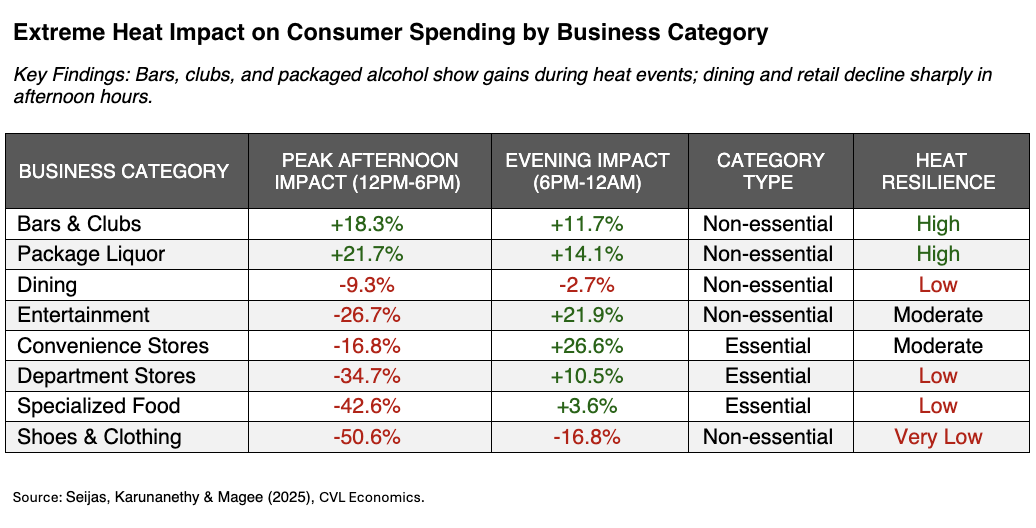
The type and degree of impact on retail categories varies. Bars, clubs, and packaged alcohol sales see gains; dining and department stores see losses. Perhaps most striking: even retailers housed in air-conditioned shopping centers experience sharp afternoon declines. The barrier, then, is not necessarily the temperature inside; it's the time spent moving outside moving between places of residence and places of commerce.
Five Insights for Nighttime Economy and District Strategy
- The nighttime economy is climate adaptation infrastructure. Evening and nighttime commercial districts demonstrate measurable resilience that daytime-dependent retail does not. When afternoon commerce contracts, evening activity absorbs some of that demand. This positions entertainment districts, dining corridors, and cultural venues not as discretionary amenities but functional components of urban climate response.
- Temporal access matters as much as spatial proximity. The 15-minute city model assumes that bringing services closer makes them more accessible. But proximity means little if services are unavailable—or conditions are inhospitable—during the hours people need them.
- Extended operating hours are a resilience strategy. Businesses that can flex their hours—opening earlier, staying open later—are better positioned to capture demand displaced from peak heat hours. Cities can support this through regulatory flexibility, extended transit service, and lighting and safety investments that make evening activation viable.
- Recovery spending concentrates in the early evening. The research shows that post-heat spending rebounds occur primarily between 6pm and 9pm. This window represents a strategic opportunity for districts seeking to capture deferred demand—and an argument for ensuring that infrastructure, programming, and business operations support that window.
- Indoor climate control does not neutralize heat impacts. The assumption that shoppers will seek refuge in air-conditioned environments during heat events does not hold. The deterrent effect of extreme outdoor conditions extends to travel and trip-making, not just destination comfort. This has implications for how retail and entertainment districts plan activation strategies during heat events.
Strategic Relevance for Municipalities
- For cities developing nighttime economy strategies, these findings reframe the policy conversation. Investments in lighting, public safety, transit frequency, and evening programming are not simply quality-of-life enhancements—they are climate resilience measures. Regulatory audits should assess whether zoning, permitting, and operating-hour restrictions inadvertently constrain temporal adaptation. Economic impact analyses should account for the differential resilience of day versus evening commerce.
- For cultural districts and entertainment corridors, the findings underscore a competitive advantage that has not been fully articulated: evening activation is climate-adaptive activation. Districts that can offer safe, accessible, and vibrant evening experiences are positioned to absorb demand that daytime environments cannot hold.
- For economic development agencies, the research suggests a new risk factor to incorporate into strategy. Sectors and businesses locked into daytime operating models face structural vulnerability to heat disruption. Diversifying the temporal profile of commercial activity—extending hours, supporting evening and nighttime operators—reduces aggregate climate exposure.
The Frontier of Climate-Adaptive Urbanism
Urban resilience has long been framed as a question of space: where to build, what to plant, how to cool. As extreme heat events become more frequent, the cities that thrive will be those that govern across the full 24-hour cycle—recognizing that the nighttime economy is not a peripheral amenity but essential infrastructure for a warming world.
For more on the underlying research:
Seijas, A., Karunanethy, S., & Magee, D. (2025). Adaptive urban economies: evidence of intra-day temporal behavioural adaptation to extreme heat in Australian cities. npj Urban Sustainability.
RELATED CONTENT