April 14, 2026
Export figures tell stories about how culture travels, where craftsmanship lives, and why certain places become synonymous with the objects they produce. Musical instruments offer a particularly revealing case. These are American-made brands with global recognition—Gibson, Martin, Fender, Zildjian, Friedman—cultural objects that sit at the foundation of a $100 billion global music industry. They are also manufactured goods, and manufacturing has always been central to place-based economic development.
U.S. Census Bureau data reveals that American musical instrument exports have declined 8.0% year-to-date through September 2025, compared to the 2021–24 average. This contraction, occurring against broader U.S. export growth of 5.2% , signals trouble in a sector where the United States has historically commanded significant global influence. American instrument makers are being squeezed from three sides: higher production costs, weakening global demand for leisure goods, and rising resistance to U.S. brands abroad. All three trace back to recent shifts in trade policy.
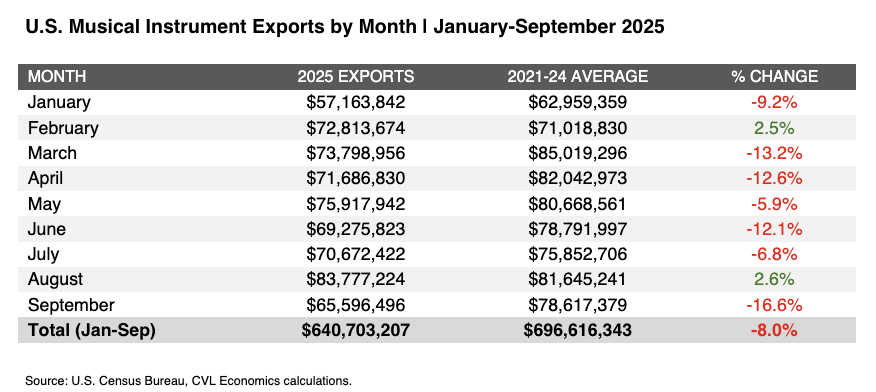
American Instrument Exports Are Declining Across Most Major Markets
U.S. musical instrument exports totaled $640.7 million in the first nine months of 2025. Double-digit drops occurred in four months with September's 16.6% contraction marking the steepest of the year. American exporters are on track for their worst performance since 2020.
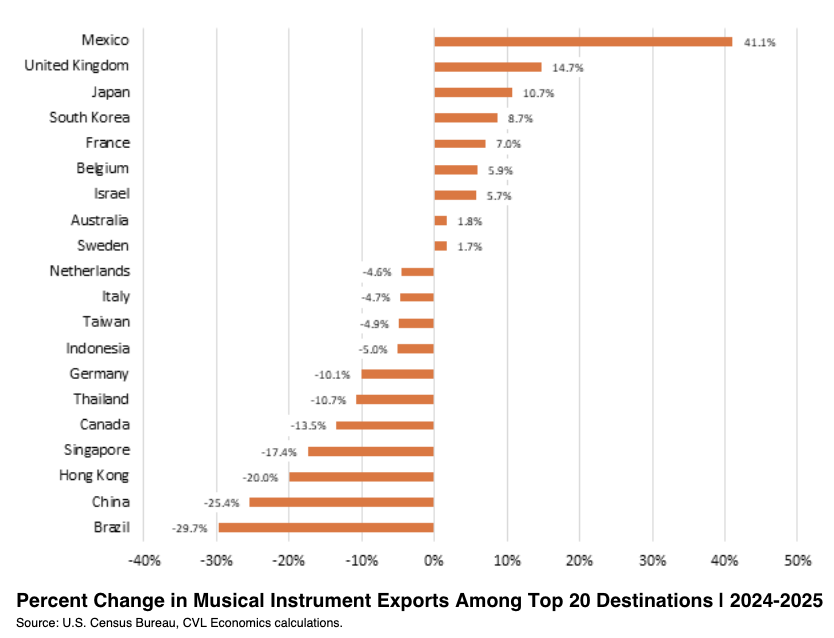
Among the top twenty destinations, the sharpest declines occurred in Brazil (down 29.7%), China (down 25.4 percent), and Hong Kong (down 20.0% ). Canada fell 13.5%; Germany declined 10.1% . Exports to the United Kingdom grew 14.7 percent, while Japan increased 10.7% . Mexico surged 41.1% —likely reflecting supply chain restructuring as manufacturers seek to reduce tariff exposure. The Netherlands remains the largest single destination at $99.5 million, followed by Japan at $91.4 million and Canada at $83.3 million.
The Three-Sided Squeeze on American Manufacturers
The decline is not primarily the result of retaliatory tariffs—most U.S. trading partners have refrained from such measures. Instead, tariffs are operating through indirect channels that compound one another.
- Higher input costs: Even for made-in-the-USA instruments, critical components are often sourced abroad or from domestic suppliers now protected from price competition. Section 232 tariffs on steel and aluminum—dating to 2018 but continued through successive administrations—have pushed up prices for metal parts, housings, and hardware. Section 301 tariffs on China have increased costs for pickups, wiring harnesses, and electronic components since 2018. Exotic tonewoods like ebony, Indian rosewood, and mahogany cannot be sourced domestically; the United States lacks the climate. Any tariffs affecting these materials—including those potentially resulting from active Section 232 investigations into lumber—cannot result in onshoring and will only translate into higher costs or substitution for sonically and visually inferior alternatives.
- Weakening demand: Musical instruments are leisure goods. When economic uncertainty rises, consumers delay purchases. The current environment—characterized by inflation concerns, volatile policy signals, and dampened confidence—has pushed potential buyers to wait. Entry-level instruments, which depend on global supply chains to maintain accessible price points, face the most acute pressure. If families cannot afford a first guitar or school districts cannot equip band programs, the long-term pipeline of musicians erodes.
- Consumer resistance to American brands: This may be the most underappreciated factor. In the aftermath of April 2025's tariff announcements, European consumers indicated willingness to shift purchases away from U.S. products, citing changing preferences more frequently than anticipated price increases. Grassroots "buy local" campaigns have emerged across Europe and Canada. Canadian retailers are running "buy Canadian" promotions.
These dynamics hit musical instruments particularly hard. Instruments are heavily branded. Country of origin is widely known. And musicians operate in a social milieu where image matters—where affecting an oppositional stance is often rewarded. Consider the Canadian drummer deciding whether to show up to a Toronto club gig with a new set of American-made Zildjian cymbals when Canadian-made Sabians are available. In the midst of a trade war, the choice becomes not just a matter of preference but one of identity and solidarity. Economic nationalism inflames nationalist passions abroad. U.S. trade policy is eroding not just American manufacturers' cost competitiveness but their cool.
Place, Manufacturing, and Cultural Identity
Musical instruments occupy a unique place U.S. goods production: they sit at the intersection of manufacturing, artisanal craft, and cultural expression. A guitar assembled in California may contain components from sixteen countries. The materials—woods that resonate at precise frequencies, metals tempered for particular tonal qualities—cannot be easily substituted or relocated.
This is an industry where place matters. Pennsylvania brass, German woodwinds, Japanese drums, Italian strings, American electric guitars: these associations result from generations of craft knowledge, specialized workforce development, and regional identity formation. When a region hosts instrument manufacturers, it typically supports specialized suppliers, repair services, music retail, education programs, and performance venues. These elements reinforce one another. A community known for instrument making attracts musicians, educators, and entrepreneurs who strengthen the broader creative economy.
Trade disruption that undermines the manufacturing base cascades through these interconnected systems. And the craft knowledge embodied in heritage manufacturing is difficult to reconstitute once lost.
Strategic Implications for Cultural Economy Investment
Several insights emerge for policymakers and economic development practitioners.
- Cultural goods are globally traded economic assets: Musical instruments account for a small fraction of total trade volume, but their cultural significance and brand recognition far exceed their statistical footprint. Regions that nurture these industries benefit from association with globally recognized products and the ecosystems surrounding them.
- Heritage industries require patient investment: Training a skilled instrument craftsperson takes months to years; mastery may require decades. Unlike many manufacturing sectors, this work cannot be rapidly relocated or easily automated. Abrupt policy shifts impose disproportionate burdens on small and mid-sized manufacturers lacking resources to navigate volatile regulatory environments.
- Export capacity builds regional resilience: Regions selling cultural goods globally develop insulation against local economic fluctuations while building external recognition that supports tourism and talent attraction. Current conditions are undermining precisely this capacity.
- Entry-level access determines long-term market health: The pipeline producing professional musicians and serious hobbyists begins with affordable starter instruments. Conditions constraining entry-level access will eventually undermine the entire ecosystem—from manufacturers to retailers to performance venues to the communities that host them.
CONCLUSION
The decline in U.S. musical instrument exports signals stress in a sector that exemplifies American cultural production at its most globally competitive. These are not abstract trade flows. They represent iconic brands, skilled manufacturing jobs, and the physical objects through which people access creativity, express identity, and connect with musical traditions spanning generations.
For communities building economic strategies around arts, culture, and creative manufacturing, the musical instrument sector offers both warning and instruction. The places that thrive will recognize cultural production as a globally competitive industry worthy of strategic investment—and protection from policy volatility that erodes both cost competitiveness and the intangible value of American cultural prestige.
RELATED CONTENT